 Applied Energistics 2
An Example "Main Network"
Many other setups reference a "Main Network". You might also ask how all these devices come together into a functional system. Here is an example:
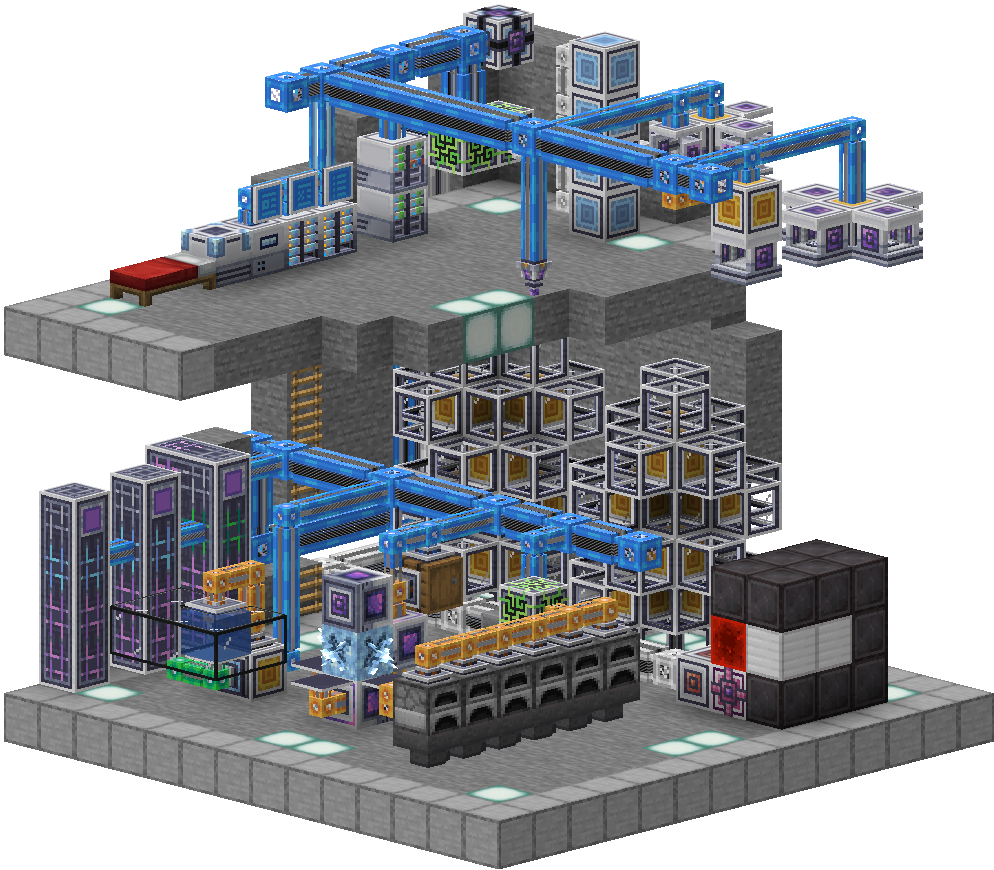
A big cluster of pattern providers and assemblers give a lot of space for crafting, stonecutting, and smithing patterns. The checkerboard pattern allows providers to utilize multiple assemblers in parallel while keeping it compact. Groups of 8 make it impossible for channels to route incorrectly.
You don't actually need that big of a controller, all those huge rings and cubes designs you see in people's bases are mainly just to look cool.
Every good network has an energy cell, to allow higher energy input per gametick and smooth out power fluctuations.
You probably want to use some other mod's power source, a reactor or solar panel or generator or whatever. Vibration Chambers are ok-ish but AE2 is designed to be used in a modpack and use your base's main power generator.
Facades can be used to hide stuff behind walls.
You don't need that many drive bays and cells for your general storage, 2–4 Drives worth of 4k or 16k cells is almost always enough.
For bulk storage, you want big cells filtered to specific items, in separate drives set to a higher priority.
Interface-based auto-stocking.
The logical expansion of the charger automation setup to multiple chargers.
Another way to automate processors, since inscribers can now auto-eject the output in 1.20.
The wireless access point is in the middle because its range is spherical.
Typically you'll have 1–2 big crafting CPUs for big jobs and a few smaller ones to handle secondary jobs while the big CPUs are busy.
Sometimes subnets might need their own controller if there are more than 8 devices (like distributing to more than 8 places).
Certus farm.
Throwing-In-Water automation.